As a small business owner, you don’t have time for complicated tech or confusing jargon. You need a website that brings in customers, period. This guide cuts through the noise. By the end of this article, you’ll know exactly which website platform is the right fit for your business—one that you can manage yourself to attract more customers and save valuable time. We'll compare 12 top options, breaking down who they're for, what they cost, and how fast you can get a professional site live. No theory, just results.
This isn't another generic feature list. We're giving you a direct comparison of the tools you need to build a website that works as hard as you do. Each recommendation includes a clear breakdown of pros and cons, who it's for (e.g., a local plumber, an online store, or a consultant), and specific features that can speed up your work. You'll see exactly what makes each platform a strong choice, from simple drag-and-drop editors to powerful online store capabilities.
For small businesses looking to sell online, mastering how to write product descriptions that truly sell can turn website visitors into loyal customers. We've evaluated how each platform supports this critical task.
Our goal is to help you make a smart decision without the technical headache. We've included screenshots, direct links, and quick setup tips for each option. This list is designed to help you stop guessing and start building a powerful online presence that generates real business. Let's find the perfect fit for you.
1. ReadyWeb AI Blog
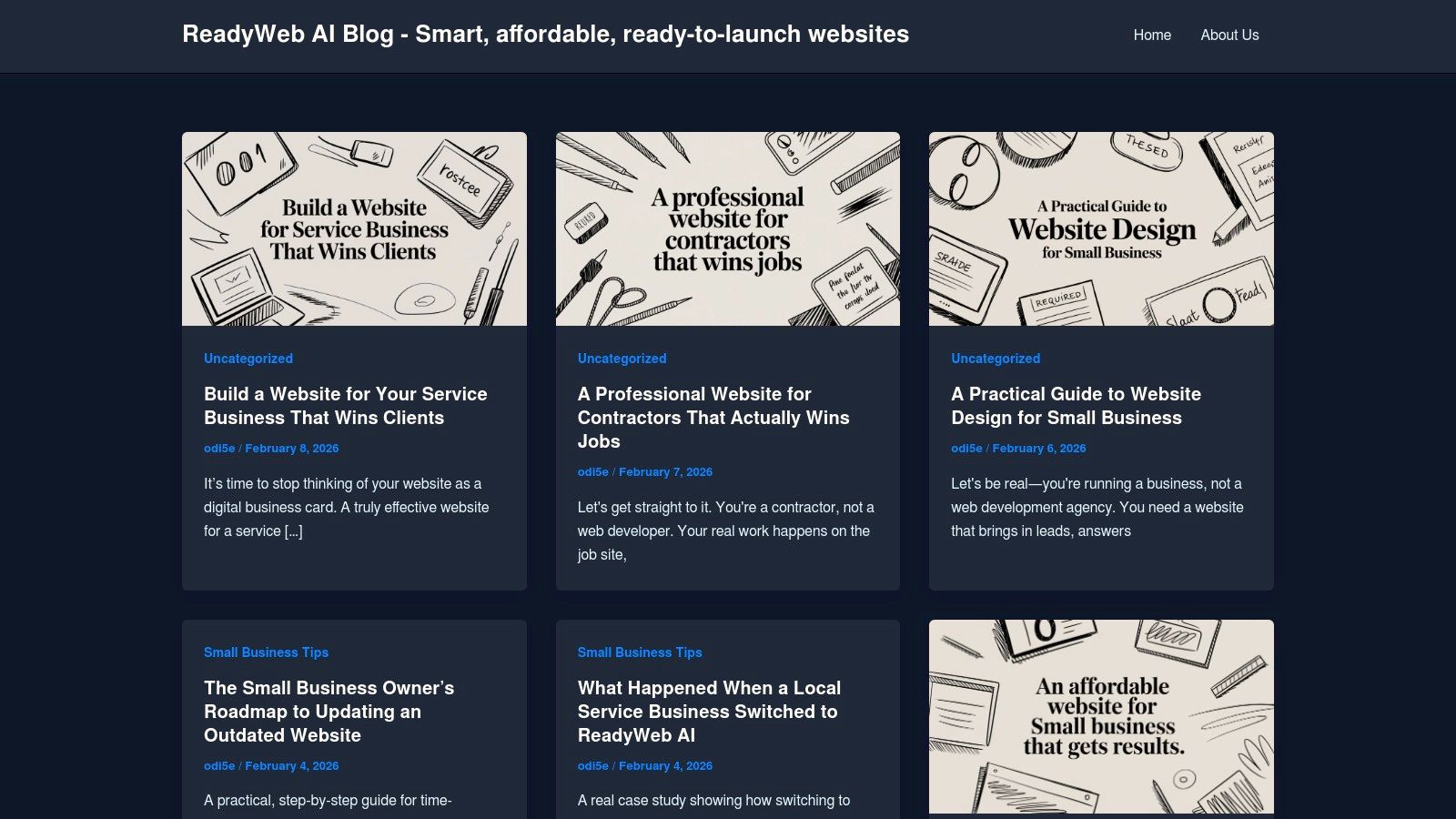
For small business owners who need to build or improve their website but lack the time or technical skills, the ReadyWeb AI Blog is a great starting point. It stands out by delivering simple, practical guides specifically designed for non-technical users. Instead of complicated theory, this resource provides step-by-step instructions and real-world examples that show you exactly how to get results. It’s the ideal resource if your goal is to create a professional website quickly and turn it into a lead-generating machine without getting bogged down in jargon.
Why It's a Top Resource for Small Business Owners
The blog's core strength is its focus on practical application. Articles like "How to Build a Professional Website in an Afternoon" are not just titles; they are actionable playbooks. A standout case study shows how a service business used these strategies to increase its leads, providing real proof that these methods work. This focus on clear business benefits, such as saving time and attracting more customers, makes it one of the best website for small business owners resources available today. The content is easy to read and focused entirely on the information you need.
Key Strengths & Use Cases
- Actionable, Short-Form Content: The blog prioritizes quick wins. You’ll find tutorials that get straight to the point, perfect for busy entrepreneurs who need to implement a solution and move on.
- AI Tools Explained Simply: It demystifies AI for web creation, offering lists of helpful tools and showing how to use them to be more productive.
- Real-World Examples: Case studies provide a before-and-after look at how other small businesses have achieved measurable success, offering both inspiration and a practical roadmap.
Limitations to Consider
- Limited Content Library: As a newer resource, its article collection is still growing. You may not find deep dives on highly specific or advanced topics.
- No Direct Commercial Information: The blog focuses purely on educational content. For pricing or service details, you will need to navigate to their main site or contact them directly.
Website: https://blog.readywebai.com
2. Shopify
For small business owners whose main goal is selling products online, Shopify is the undisputed leader. It's a complete, all-in-one platform designed to get you selling quickly. Shopify handles everything from your online storefront and secure checkout to inventory management and shipping. It’s the best website for small business owners who are serious about e-commerce.
Its core strength is that it can grow with your business. You can start with a basic plan and expand to a large-scale operation without ever needing to switch platforms. The back-end is straightforward, making it simple to add products, track orders, and see how your sales are doing.
Key Considerations
Shopify’s system is reliable and secure, with 24/7 customer support ready to help. While it excels at selling products, it's less suited for sites where sales are not the main goal, like a simple blog or a portfolio.
- Ideal Use Case: Businesses selling physical or digital products that need a reliable, scalable online store with powerful sales tools.
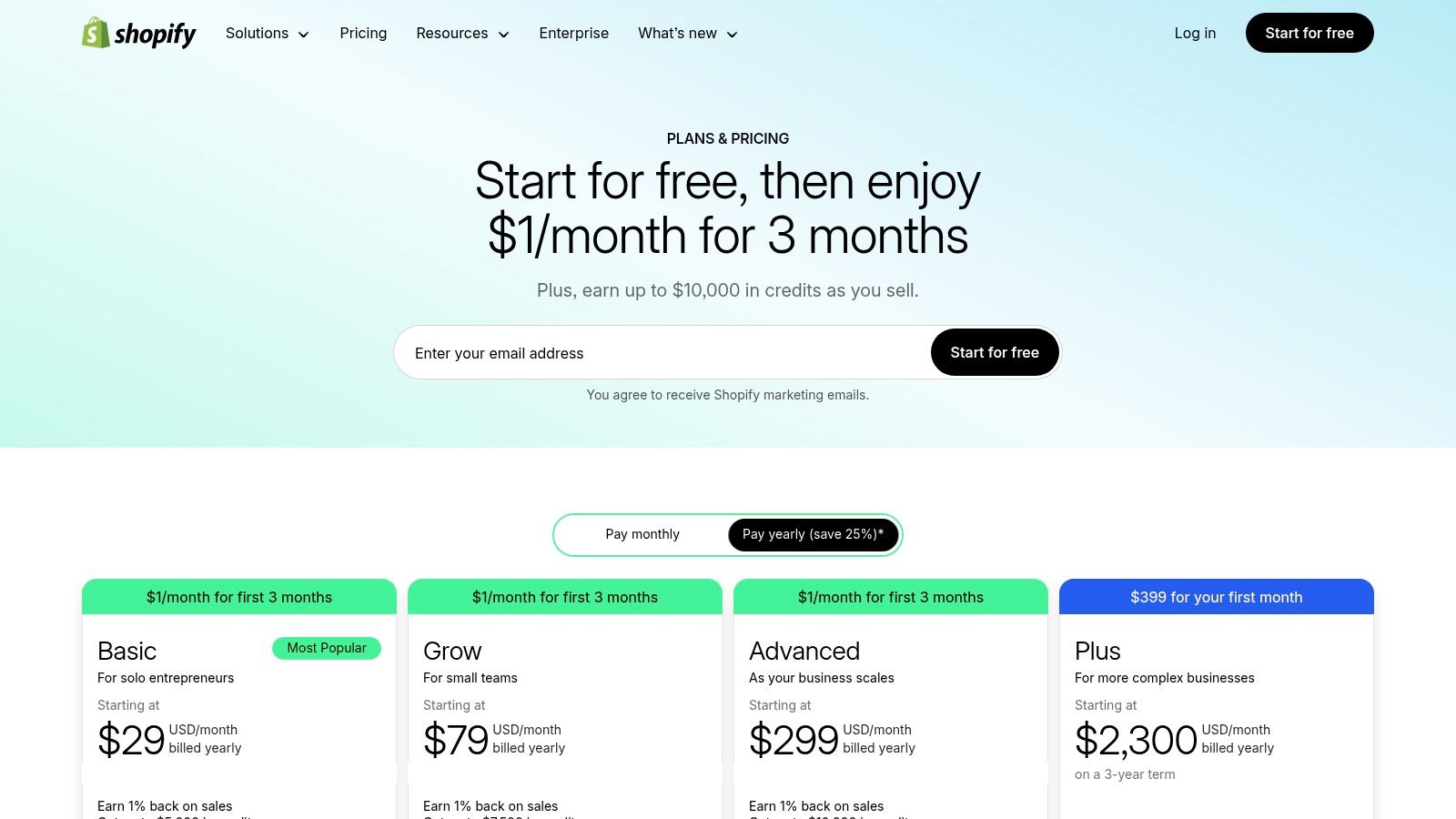
- Pricing: Plans start at $29/month (billed annually) for the "Basic" tier.
- Practical Tip: Use the Shopify App Store. Start with essential apps for email marketing (like Klaviyo) and customer reviews to build trust and automate your marketing from day one.
Before/After Scenario: Before Shopify, a local artisan might struggle with taking orders over social media DMs and managing payments. After setting up a Shopify store, they have a professional website that automatically processes payments, tracks inventory, and calculates shipping, freeing them up to focus on creating their products.
| Feature Highlights | Pros | Cons |
|---|---|---|
| All-in-one e-commerce platform | Grows with your business, from small to large | Charges transaction fees if you don't use Shopify Payments |
| Built-in payment processing & discounted shipping | Excellent tools for inventory and order fulfillment | App costs can add up quickly |
| Huge app store for adding new features | Reliable performance and 24/7 support | Not ideal for non-e-commerce sites |
| Sells on social media, in-person, and marketplaces | Easy to use for managing products and orders | Limited design customization without hiring a developer |
Website: https://www.shopify.com/pricing
3. Wix
For business owners who want total creative control and a fast, code-free launch, Wix is a top contender for the best website for small business owners. It's a flexible, drag-and-drop platform that lets non-technical users build a professional-looking site quickly. Wix offers a complete package, including e-commerce, appointment booking, and marketing tools, all in one place.
Its main appeal is the design freedom. You can place any element anywhere on the page, like arranging furniture in a room. For an even faster start, the Wix Artificial Design Intelligence (ADI) can generate a complete website for you in minutes based on a few simple questions.
Key Considerations
Wix handles all the technical background work like hosting and security, so you can focus on your content. While its flexibility is a huge plus, this freedom can sometimes be overwhelming. Also, once you choose a template (a pre-made design), you can't easily switch to another without rebuilding your site.
- Ideal Use Case: Service-based businesses (consultants, artists, restaurants) and small shops who want maximum design flexibility without writing code.
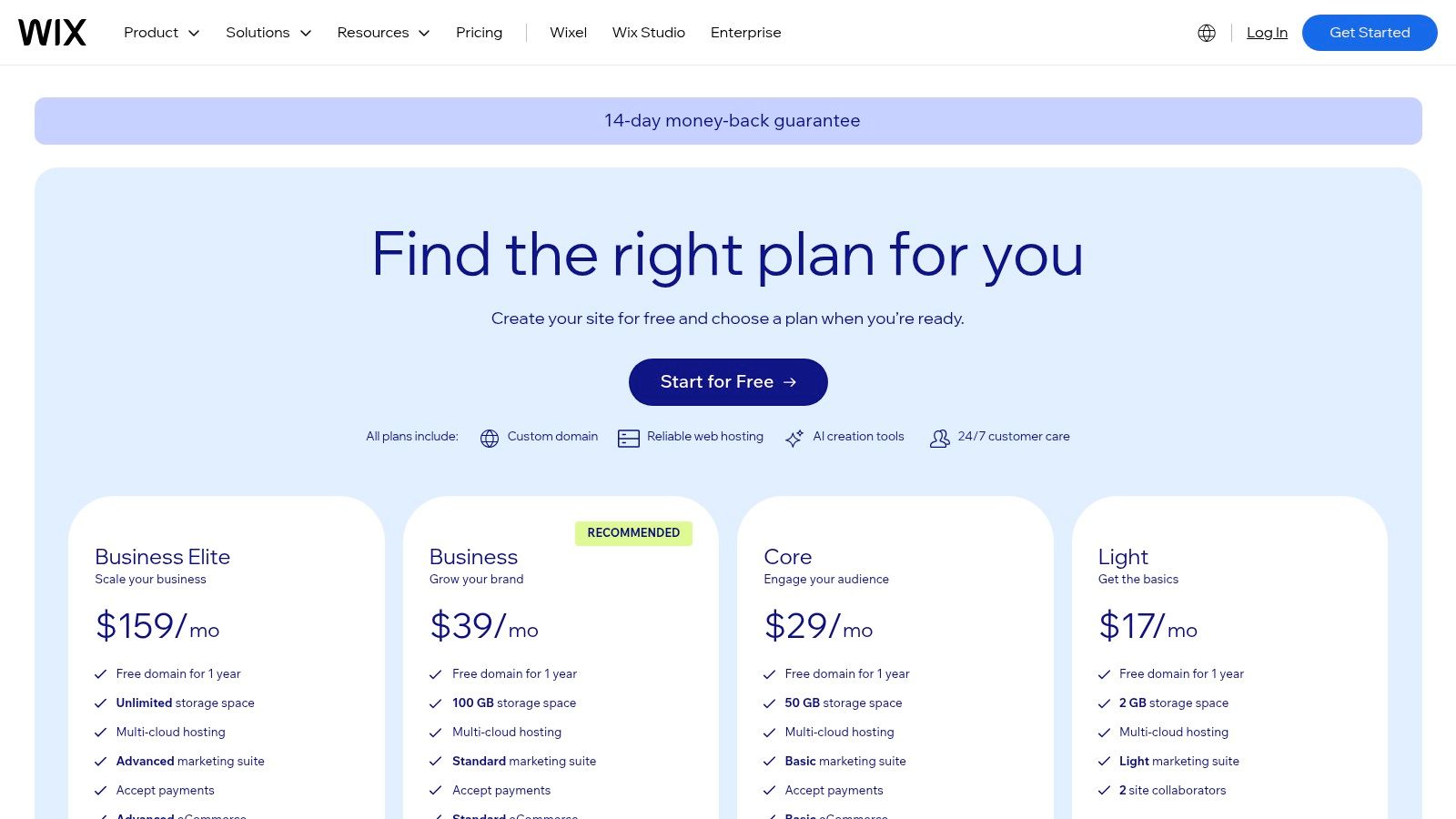
- Pricing: A limited free plan is available. Paid plans for professional sites start at $17/month (billed annually).
- Practical Tip: Start with Wix ADI to get a functional, well-designed site foundation. You can then switch to the full Wix Editor to fine-tune the details, giving you the best of both worlds: speed and customization.
Before/After Scenario: A local contractor relies on word-of-mouth. With a Wix site built in an afternoon, they now have a professional online gallery of their work, a contact form for quotes, and show up in local search results, bringing in a steady stream of new leads.
| Feature Highlights | Pros | Cons |
|---|---|---|
| Visual drag-and-drop & AI site creation (ADI) | Extremely easy for beginners to get started | Costs can increase with premium app usage |
| Built-in e-commerce, booking & marketing suite | Go from an idea to a live website very quickly | Moving your site away from Wix is difficult |
| Large template and app selection | Free plan available to test the platform | Can't switch templates after your site is live |
| Hosting and 24/7 support included | High degree of design customization and flexibility | Performance can be slower on heavily customized sites |
Website: https://www.wix.com/plans
4. Squarespace
For service-based businesses, creatives, and anyone who wants a polished design with minimal effort, Squarespace is often the best website for small business owners. It's an all-in-one platform known for its award-winning, visually stunning templates that look professional right out of the box. Squarespace combines an easy-to-use editor with powerful, built-in tools for scheduling, e-commerce, and marketing.
Its key advantage is the seamless, all-in-one experience. Everything from your website traffic reports and email campaigns to your online store is managed from a single, clean dashboard. This integrated approach simplifies the technical side of running a website, letting you focus on creating beautiful content and serving your clients.
Key Considerations
Squarespace's all-in-one system means you get reliability and great design without needing to manage extra software or security updates. While it's incredibly powerful for its intended audience, it offers less flexibility for very specific functions compared to a platform like WordPress. For a deeper dive into how it stacks up against other options, consider exploring a detailed small business website builder comparison.
- Ideal Use Case: Service professionals, photographers, artists, bloggers, and restaurants who need a beautiful website with built-in business tools.
- Pricing: Personal plans start at $16/month (billed annually).
- Practical Tip: Use the integrated Acuity Scheduling tool (available on Business plans and up). It allows clients to book appointments directly on your site, syncing with your calendar and handling payments automatically—a game-changer for service businesses.
Before/After Scenario: A yoga instructor juggles texts and emails to schedule classes. With a Squarespace site using Acuity Scheduling, clients can now see her availability online, book a spot, and pay in advance, completely automating her booking process and reducing no-shows.
| Feature Highlights | Pros | Cons |
|---|---|---|
| Award-winning, modern templates | Beautiful, high-quality designs for all templates | Less flexible for highly custom or unique needs |
| All-in-one platform with integrated tools | Simple, unified control panel | Advanced customization requires higher-tier plans |
| Built-in commerce, scheduling & member areas | Excellent built-in analytics and SEO tools | Can feel more restrictive than other platforms |
| Hosting, security, and updates included | No need to manage third-party plugins or updates | Editor has a learning curve for complete beginners |
Website: https://www.squarespace.com/pricing
5. WordPress.com
For businesses built on content, like blogs, news sites, or portfolios, WordPress.com offers a streamlined and secure version of the world's most popular website software. It provides the power of WordPress without the technical headache of managing your own web hosting, security, and updates. This makes it a strong contender for the best website for small business owners who prioritize creating content over complex e-commerce.
Think of it as WordPress made easy. You get a managed environment where the server maintenance is handled for you, allowing you to focus purely on writing and designing your site. With plans that scale from a simple free blog to a full-featured business site, it can grow with you.
Key Considerations
WordPress.com’s managed hosting ensures your site is fast, secure, and backed up automatically. While the free and lower-tier plans are limited, upgrading to a Business plan unlocks the ability to install custom themes and the vast library of WordPress plugins, giving you nearly limitless functionality.
- Ideal Use Case: Content-heavy businesses like bloggers, consultants, and service providers who want the power of WordPress with the convenience of a managed, supported service.
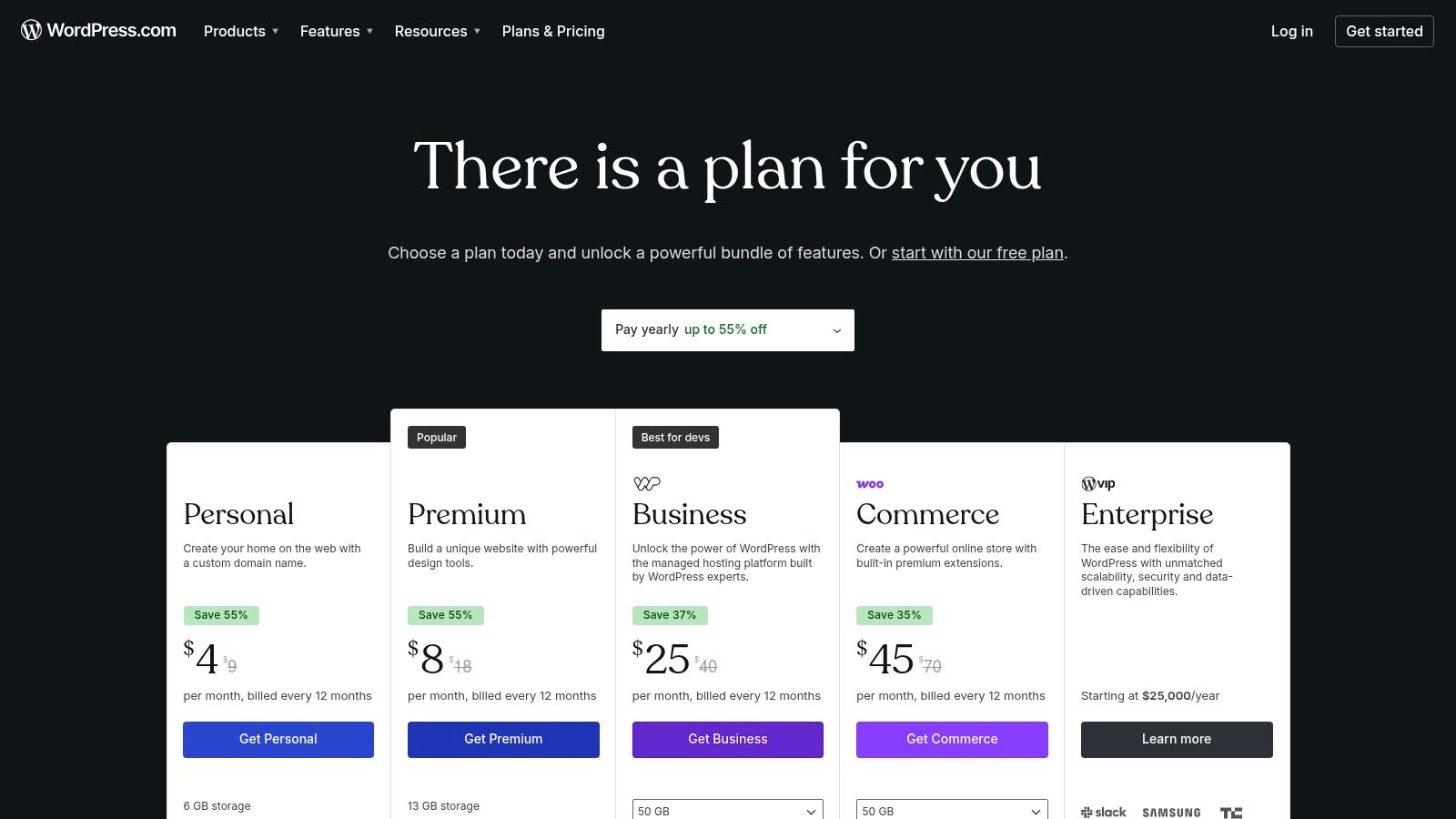
- Pricing: A free plan is available with limitations. The "Business" plan, which allows plugins, starts at $25/month (billed annually).
- Practical Tip: Start with the free or personal plan to get comfortable with the interface. Once your traffic grows or you need specific functionality (like appointment booking), upgrade to the Business plan to unlock plugins, which are the key to customizing your site.
Simple Comparison: WordPress.com is like leasing a car. You don't own it outright and can't modify the engine, but all the maintenance is handled for you. WordPress.org (our next option) is like buying a car—you have total control, but you're responsible for all the upkeep.
| Feature Highlights | Pros | Cons |
|---|---|---|
| Managed hosting with security & backups | No need to worry about server maintenance or updates | Access to plugins requires more expensive plans |
| Access to themes & plugins (on higher plans) | Low-maintenance WordPress experience | Less control than self-hosted WordPress |
| Scales from free blogs to full e-commerce | Strong focus on content creation and SEO tools | Can be more expensive than self-hosting in the long run |
| Professional support on paid tiers | A secure and reliable platform backed by experts | Free plan includes WordPress.com branding |
Website: https://wordpress.com/plans/
6. WordPress.org
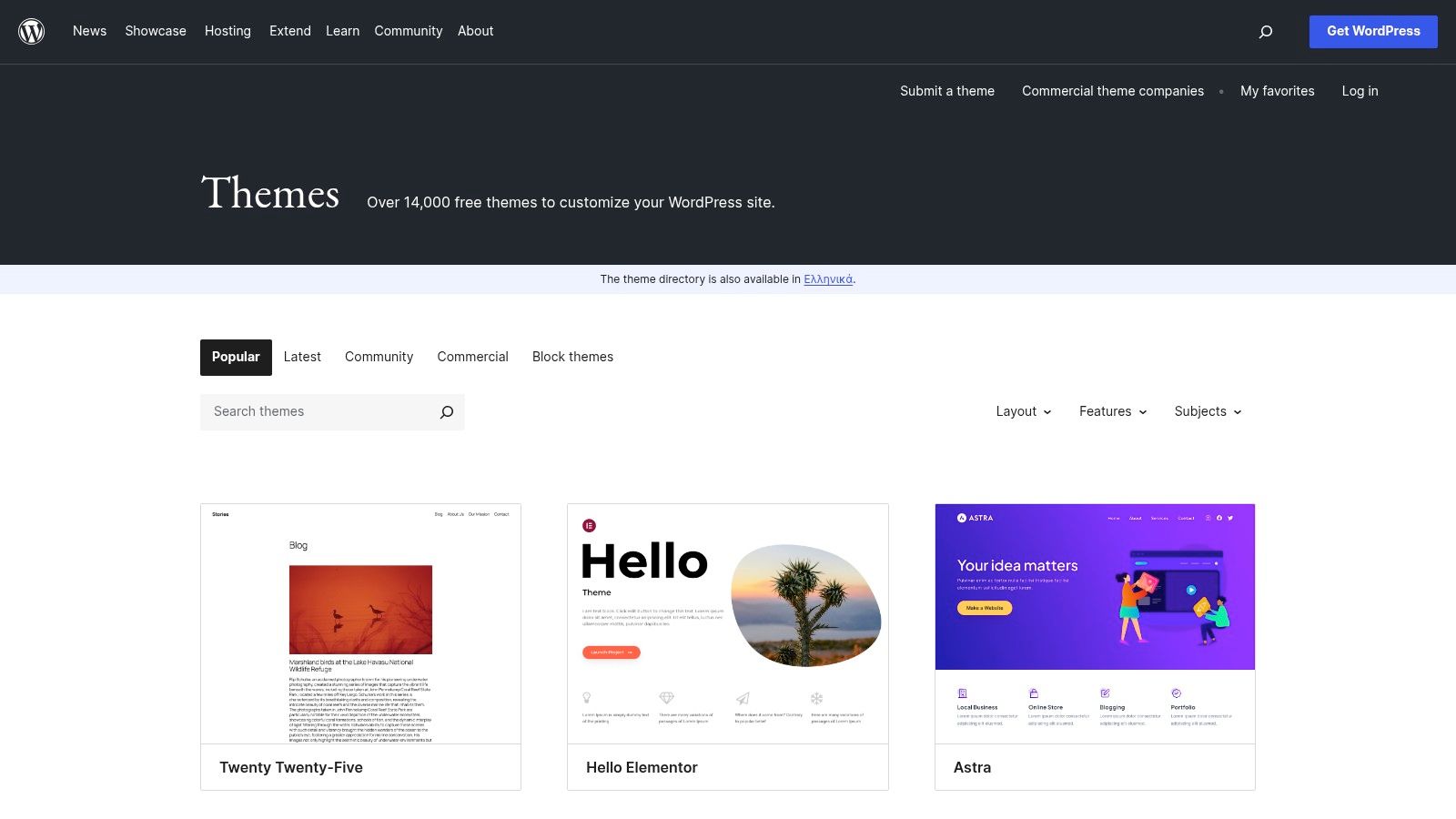
For business owners who want complete control and the ultimate in customization, WordPress.org is the gold standard. This is the self-hosted, open-source version of WordPress, meaning you own your website and have the freedom to build anything you can imagine. It powers over 43% of the web for a reason: its flexibility is unmatched, making it the best website for small business owners who need a platform that can grow and adapt to any future need.
Unlike all-in-one builders, WordPress.org gives you access to an enormous ecosystem of themes (designs) and plugins (features) to add any functionality, from advanced booking systems to complex membership sites. You choose your own hosting company, giving you control over performance and cost.
Key Considerations
The trade-off for this immense power is responsibility. You are in charge of finding a hosting provider, performing software updates, and managing your own security. While this involves a steeper learning curve than a hosted builder, the vast community and endless online tutorials provide resources for nearly any challenge.
- Ideal Use Case: Content-heavy sites like blogs, news portals, and businesses requiring highly specific, custom features that can't be found on template-based builders.
- Pricing: The WordPress software itself is free. Costs come from web hosting (typically $5-$30/month to start), a domain name, and any premium themes or plugins.
- Practical Tip: Start with a "managed WordPress host" like SiteGround or WP Engine. They handle many of the technical tasks like daily backups, security monitoring, and core updates, which significantly reduces the management burden.
Simple Comparison: WordPress.org is like owning your own building instead of renting a storefront. You have complete freedom to renovate and expand, but you're also responsible for the plumbing and security. All-in-one builders are like renting—convenient, but with limitations on what you can change.
| Feature Highlights | Pros | Cons |
|---|---|---|
| Open-source software with full control | Unlimited customization and integration options | Requires you to choose a host and handle security |
| Massive theme and plugin ecosystem | You have complete ownership of your website and data | Steeper learning curve for non-technical users |
| No platform restrictions or lock-in | Cost-effective as hosting is the primary expense | You are responsible for maintenance and updates |
| Huge community and free resources available | Scales from a simple blog to a complex enterprise site | Quality of themes/plugins can vary widely |
Website: https://wordpress.org/themes/
7. ThemeForest (Envato Market)
For small business owners using WordPress, ThemeForest is a game-changer. It's not a website builder itself, but a huge marketplace offering thousands of premium website themes (pre-made designs). This makes it one of the best website for small business owners resources for getting a professional, feature-rich design without the cost of a custom build. You can find highly specific themes built for virtually any industry, from restaurants to construction companies.
The platform's strength is its vast selection and transparency. You can see how many times a theme has been sold, read user reviews, check its update history, and even test a live demo before you buy. This helps you purchase a well-supported and high-quality design, giving you a powerful head start on building your site.
Key Considerations
ThemeForest provides a cost-effective path to a high-end look, but the quality and level of support can vary significantly between different theme creators. It’s crucial to research the creator's reputation and ensure the theme is well-documented and regularly updated before buying.
- Ideal Use Case: WordPress users who need a powerful, industry-specific website design with extensive features and customization options right out of the box.
- Pricing: Themes are a one-time purchase, typically ranging from $29 to $79, which usually includes future updates and six months of author support.
- Practical Tip: Don't just look at the design. Pay close attention to the theme's "Last Updated" date, user ratings, and comments section. A recently updated theme with active author responses is a strong indicator of quality and reliability.
Why It's a Top Choice: ThemeForest lets you achieve a custom-coded look for a fraction of the price. It accelerates your website launch by providing a complete, professional design framework, so you can focus on adding your content and growing your business.
| Feature Highlights | Pros | Cons |
|---|---|---|
| Thousands of paid WordPress themes | Huge selection and competitive one-time pricing | Quality and support vary greatly by theme creator |
| Public ratings, sales counts & update history | Easy to find niche designs for specific business types | Feature-heavy themes can slow down your site |
| Licenses include future updates & author support | Instant digital delivery and extensive customization | May have a steeper learning curve than all-in-one builders |
| Live previews to test designs before purchase | Reviews and sales data help identify quality products | Some themes require paid plugins that cost extra |
Website: https://themeforest.net/category/wordpress
8. Bluehost
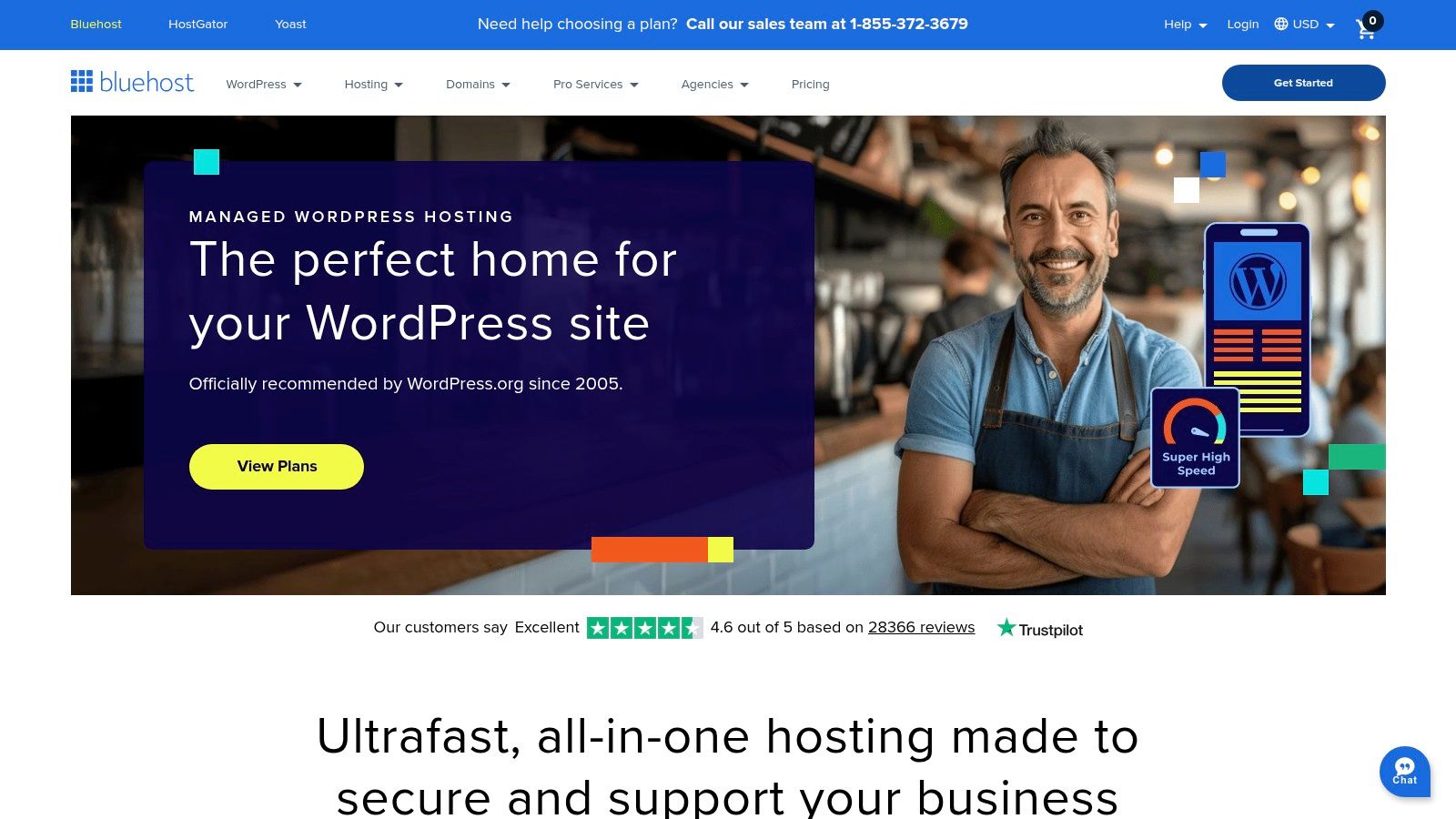
For small business owners who want the power of a self-hosted WordPress site without the technical intimidation, Bluehost is a top entry point. Officially recommended by WordPress.org, it provides an affordable and streamlined path to launching a professional site. Bluehost simplifies the setup process with a one-click WordPress installation, a free domain name for the first year, and an AI-powered site creator to get you started quickly.
Its main value is providing an accessible on-ramp to the world's most popular website platform. The system is designed for beginners, offering automated WordPress updates and a user-friendly control panel to manage your site. This makes it an excellent choice for those who need a solid foundation for their blog, portfolio, or service-based business website but aren't ready for more complex hosting.
Key Considerations
Bluehost's hosting is optimized for WordPress, ensuring your site runs smoothly. Included features like a free SSL certificate (for security) and CDN (for speed) help right out of the box. While its introductory pricing is very attractive, be mindful that renewal rates are significantly higher. This platform is the best website for small business owners taking their first step into the expansive WordPress world.
- Ideal Use Case: New businesses, bloggers, and service providers who want an affordable, reliable host to build a custom WordPress website with full control.
- Pricing: Introductory shared hosting plans often start as low as $2.95/month.
- Practical Tip: Use the AI-powered site creator to generate initial content and select a design theme. This gives you a strong starting point, which you can then customize to perfectly match your brand. Understanding the fundamentals of website design for small business will help you make the most of this customization.
Why It's a Top Choice: Bluehost makes WordPress hosting less scary. It removes the initial technical barriers with guided setup and essential tools, empowering business owners to build a powerful, scalable website on a budget.
| Feature Highlights | Pros | Cons |
|---|---|---|
| One-click WordPress installation | Very low introductory pricing makes it budget-friendly | Renewal rates are significantly higher than promo prices |
| Free domain name for the first year | Officially recommended by WordPress.org | Shared hosting can be slower than premium hosts |
| Free SSL, CDN, and automated updates | 24/7 customer support and a 30-day money-back guarantee | Tries to sell you add-ons during checkout |
| AI-assisted site builder | User-friendly dashboard for beginners | Performance can vary on the cheapest plans |
Website: https://www.bluehost.com/wordpress-hosting
9. Square Online (by Block)
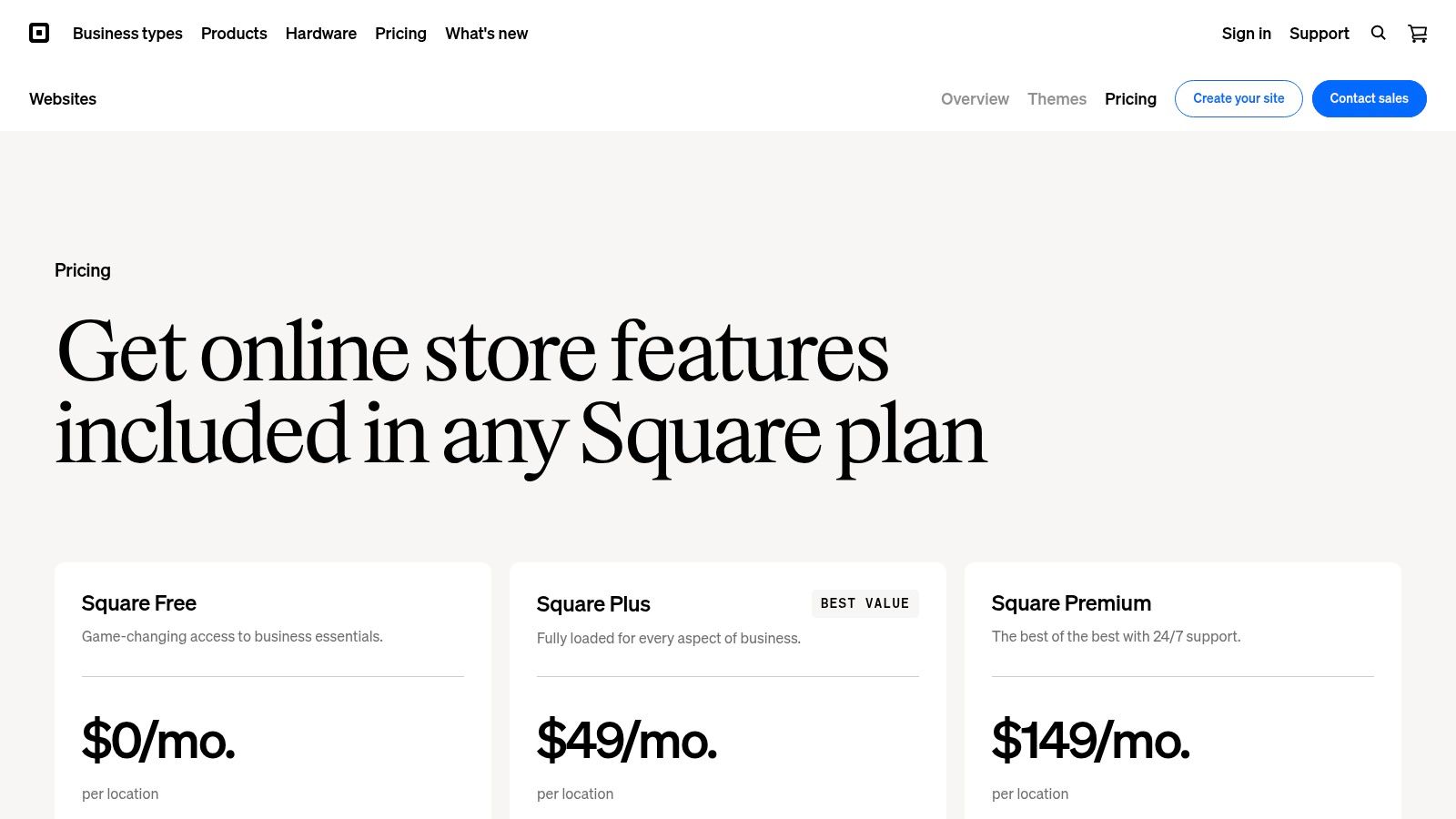
For local businesses that mix in-person and online sales, Square Online is an exceptional choice. If you run a cafe, retail shop, or service business already using Square's payment system (the little white card reader), this platform offers seamless integration that no competitor can match. It's designed to unify your entire operation, automatically syncing inventory, sales, and customer data between your physical and digital storefronts.
The core advantage is this automatic synchronization. When you sell an item in-store, your website's inventory updates instantly, and vice versa. This removes the headache of managing two separate systems. The platform also includes built-in tools for local businesses, such as online ordering for in-store pickup, local delivery management, and appointment booking, making it one of the best website for small business owners focused on their local community.
Key Considerations
Square Online's tight integration with its payment system means setup is incredibly fast, especially for existing Square users. While its design customization is more limited than platforms like Wix or Squarespace, its features for local businesses are robust and practical. The free plan is a fantastic starting point, though processing fees apply to all online sales.
- Ideal Use Case: Restaurants, retail stores, and service providers who need a website that perfectly syncs with their in-person Square payment system.
- Pricing: A free plan is available (you only pay processing fees). Paid plans with more features start at $29/month (billed annually).
- Practical Tip: Use the built-in QR code ordering feature. You can generate codes for tables or flyers that link directly to your online menu, allowing customers to order and pay from their phones, which streamlines service.
Before/After Scenario: A local cafe owner manually updates their online menu and struggles to track inventory. With Square Online, their in-store and online menus are always synced. When a scone sells out in the cafe, it's instantly marked as "sold out" on the website, preventing customer disappointment.
| Feature Highlights | Pros | Cons |
|---|---|---|
| Seamless integration with Square payment system | Best-in-class sync for in-person and online sales | Design and customization options are less flexible |
| Built for local commerce (pickup, delivery) | Generous free plan available to start selling online | Transaction fees apply to all plans |
| Built-in appointment and order management | Strong features for restaurants and service businesses | Best suited for those already using Square |
| Accepts various payment methods (Apple Pay, etc.) | Transparent and straightforward payment processing | Not as feature-rich for purely online stores |
Website: https://squareup.com/us/en/online-store/plans
10. GoDaddy Website Builder
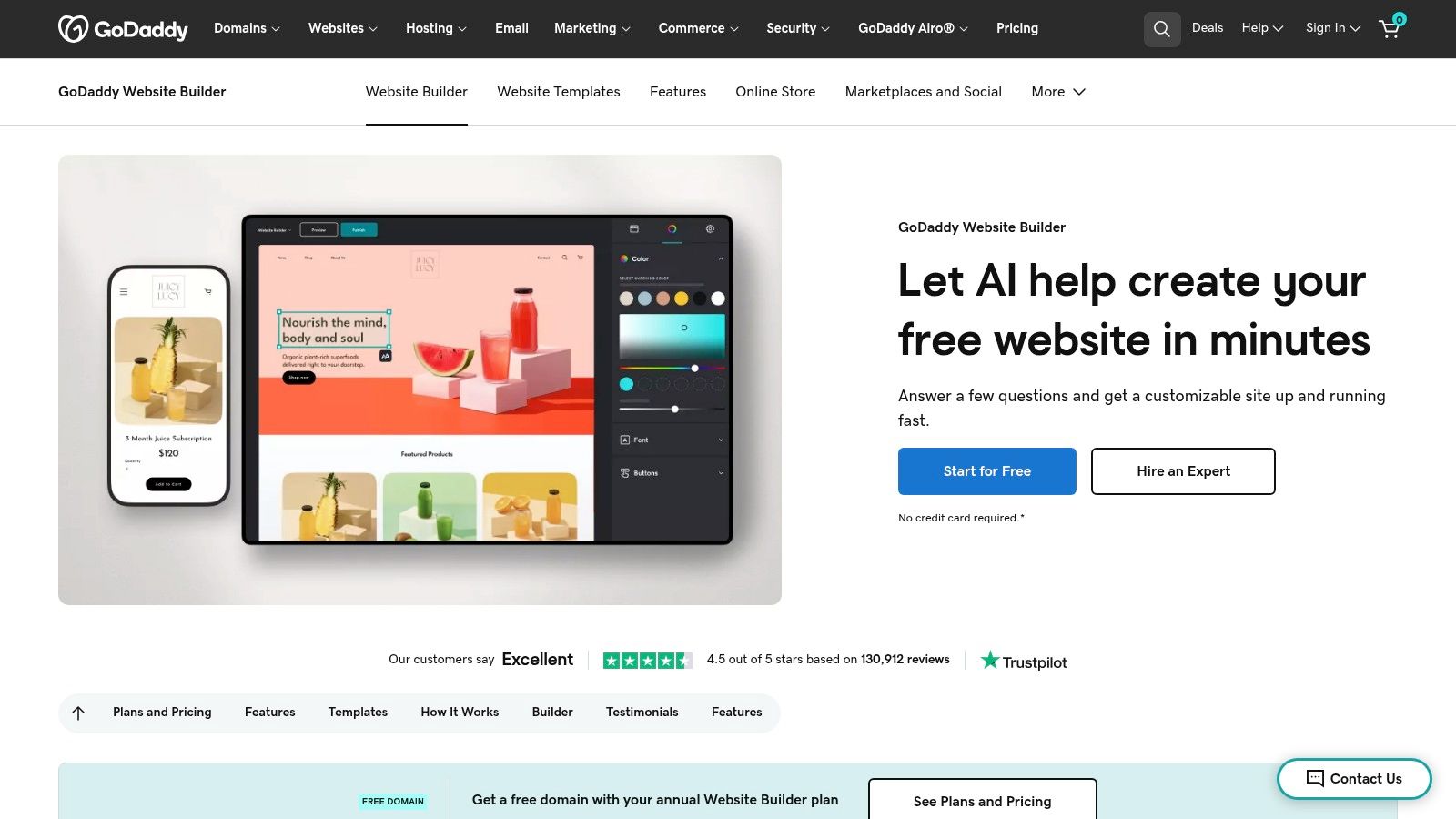
For the time-crunched business owner who values speed and simplicity above all, GoDaddy Website Builder is a top contender. It is designed to get a professional-looking site online in the shortest time possible, often in under an hour. GoDaddy asks you a few questions about your business and its AI tool, Airo, automatically generates a complete, industry-specific website with text and images, which you can then quickly customize.
This all-in-one approach is its main draw. GoDaddy bundles your domain name, website hosting, email marketing, and even appointment booking into a single, easy-to-manage dashboard. It's the best website for small business owners who want one vendor, one bill, and one login to handle their core online presence.
Key Considerations
GoDaddy prioritizes speed and convenience, which means it offers less creative freedom compared to platforms like Wix or Squarespace. Its 24/7 support is a significant advantage for business owners who might be working on their site after hours.
- Ideal Use Case: Service-based businesses (like contractors, consultants, or salons) who need a simple, professional online brochure and booking system live as quickly as possible.
- Pricing: Plans are competitively priced, often with a free trial or a free tier available. Annual plans typically include a free domain for the first year.
- Practical Tip: Use the built-in marketing tools from the start. Even the basic plans include tools for email marketing and social media posts, allowing you to announce your new site and engage customers from one central location.
Before/After Scenario: A plumber relies on an outdated phone number in the yellow pages. Using GoDaddy's builder, they create a simple, mobile-friendly site in 45 minutes that lists their services, service area, and has a "Click to Call" button. Now, customers find them on Google and can call for an emergency repair instantly from their phone.
| Feature Highlights | Pros | Cons |
|---|---|---|
| AI-assisted builder for rapid setup | Extremely fast path from idea to a published website | Less design freedom than competitors like Wix |
| Built-in email & social marketing tools | One-vendor convenience (domain, site, email, marketing) | Renewal pricing is typically higher than the intro rate |
| Appointment and booking tools included | Competitive entry-level pricing with a free trial | Can be outgrown by businesses with complex needs |
| 24/7 customer support via phone and chat | Includes a free domain for the first year on annual plans | Limited ability to add features with third-party apps |
Website: https://www.godaddy.com/websites/website-builder
11. HubSpot Content Hub (formerly CMS Hub)
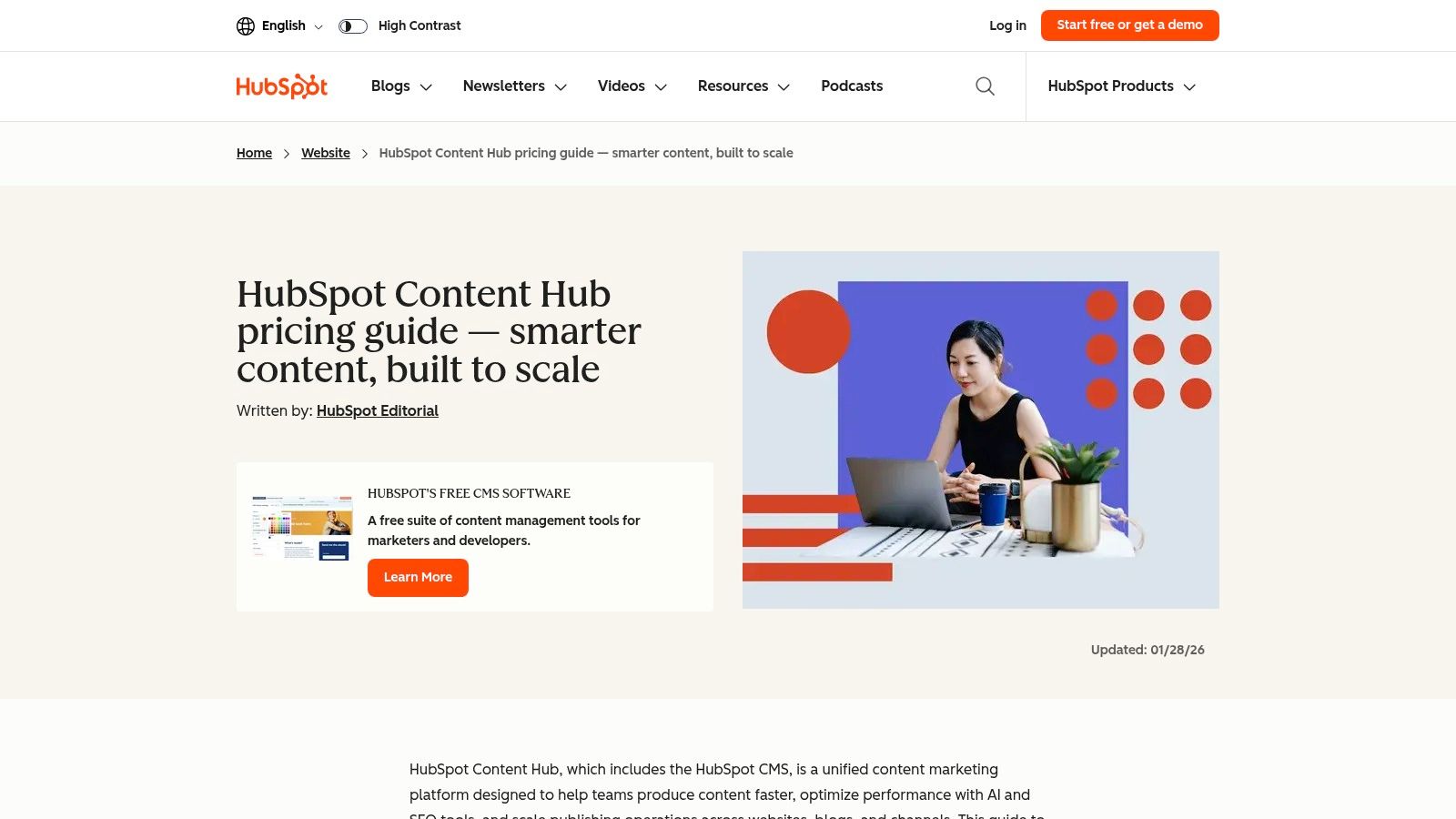
For service businesses that see their website as a core growth engine, HubSpot Content Hub is a powerful choice. It's more than just a website builder; it's a website platform deeply connected with HubSpot's world-class CRM (Customer Relationship Management) and marketing tools. This all-in-one approach allows you to create a website that not only looks professional but also actively generates, nurtures, and converts leads. This is the best website for small business owners who are serious about marketing.
The platform’s main advantage is its unified nature. Your website analytics, contact data, email campaigns, and sales pipeline all live in one place. This allows for powerful marketing, such as showing different content to a first-time visitor versus a returning customer. The drag-and-drop editor and AI-powered content tools help you create and optimize pages efficiently.
Key Considerations
HubSpot is built for businesses focused on "inbound marketing," where content like blogs and guides drives growth. Its native connection to the CRM means every form submission or live chat interaction automatically creates a rich contact profile, streamlining your sales and marketing follow-up.
- Ideal Use Case: Service-based businesses, B2B companies, and consultants who want a website that’s tightly integrated with their marketing and sales operations.
- Pricing: A free plan with HubSpot branding is available. Paid plans for the Content Hub start at $23/month (billed annually).
- Practical Tip: Start by using the free HubSpot CRM. Connect a form on your existing site to the CRM to see how it captures lead data before committing to the full website platform.
Why It's a Top Choice: It transforms your website from a static brochure into a dynamic growth machine. The built-in connection between your content and customer data provides unparalleled insight into your customer's journey, helping you personalize experiences and close more deals.
| Feature Highlights | Pros | Cons |
|---|---|---|
| Built-in connection to HubSpot CRM & marketing | Unified platform for your site, CRM, and marketing | Higher cost compared to basic website builders |
| AI‑assisted content and SEO tools | Scales from small businesses to large enterprises | Can be difficult to move away from the platform later |
| Drag‑and‑drop page building and themes | Strong personalization and testing capabilities | Overkill for simple brochure-style websites |
| Secure hosting and support included | Excellent training resources | Full feature set requires higher-priced tiers |
Website: https://blog.hubspot.com/website/hubspot-content-hub-pricing
12. Capterra
Instead of being a website builder itself, Capterra is a free-to-use software directory that helps you find the best website for small business owners by comparing hundreds of options. It acts as an independent research hub where you can discover, compare, and validate different platforms based on verified user reviews, detailed feature lists, and buyer's guides. This is the place to start your search before committing to a platform.
The site’s power lies in its robust filtering and comparison tools. You can quickly shortlist builders based on specific criteria like pricing (free plans, trials), features (e.g., SEO tools, e-commerce), and user ratings. This saves countless hours of research by putting crucial decision-making information in one place, allowing you to make a more informed choice.
Key Considerations
Capterra provides transparency with verified user reviews, giving you honest feedback from other business owners. While the directory is comprehensive, be aware that sponsored placements can sometimes affect the order of results. Think of it as a powerful research tool, not the final stop.
- Ideal Use Case: Business owners in the initial research phase who want to compare multiple website builders side-by-side based on features, price, and real-world reviews.
- Pricing: Free to use for research and comparison.
- Practical Tip: Use the filters to narrow down options to your top 3-5 choices. Then, visit each company’s website directly from Capterra to verify current pricing and take advantage of any exclusive promotions.
Why It's a Top Choice: Capterra simplifies the overwhelming process of choosing a website builder. It empowers you to make a data-driven decision by providing unfiltered user feedback and detailed comparison tools, reducing the risk of picking the wrong platform for your business.
| Feature Highlights | Pros | Cons |
|---|---|---|
| Broad directory of website builders and software | Free to use and efficient for shortlisting options | Sponsored placements can influence the order of results |
| Verified user reviews and detailed buyer's guides | Transparent review verification process | Prices shown may not always be up to date |
| Advanced filtering by features, pricing, and ratings | Excellent for direct, side-by-side comparisons | Can still feel overwhelming due to the sheer number of options |
| Direct links to vendor sites for purchase or trials | Helps discover niche or lesser-known platforms | Review details can sometimes lack specific context |
Website: https://www.capterra.com/website-builder-software/
Top 12 Website Platforms for Small Businesses — Comparison
| Product | Core features ✨ | Experience & Quality ★ | Value / Price 💰 | Target Audience 👥 | USP 🏆/✨ |
|---|---|---|---|---|---|
| ReadyWeb AI Blog 🏆 | ✨ Short how‑tos, AI workflows, WP + Astra | ★★★★ | 💰 Free insights; services via contact | 👥 Small businesses, creators, contractors, marketers | 🏆 ✨ Actionable AI‑driven guides + real case studies |
| Shopify | ✨ Hosted ecommerce, checkout, inventory, app marketplace | ★★★★★ | 💰 Tiered plans; transaction fees if not using Shopify Payments | 👥 Merchants scaling online sales | ✨ Robust commerce features & large app ecosystem |
| Wix | ✨ Drag‑and‑drop editor, AI site creation, ecommerce, bookings | ★★★★ | 💰 Free plan; premium tiers for features/apps | 👥 Non‑technical owners, creatives, small service businesses | ✨ Fast launch with wide design freedom |
| Squarespace | ✨ Design‑forward templates, commerce, member areas, email | ★★★★ | 💰 All‑in‑one subscription pricing | 👥 Creatives and service brands prioritizing aesthetics | ✨ Polished templates & cohesive admin experience |
| WordPress.com | ✨ Managed WP hosting, themes; plugins on higher plans | ★★★★ | 💰 Free tier; Business/Commerce paid tiers | 👥 Content‑heavy sites, SMBs wanting WP with support | ✨ Low‑maintenance WordPress with support options |
| WordPress.org | ✨ Open‑source CMS, themes/plugins, full code access | ★★★★ | 💰 Software free; hosting is main expense | 👥 Developers, power users needing full control | ✨ Unlimited customization, portability, massive ecosystem |
| ThemeForest (Envato) | ✨ Marketplace for premium themes with previews & ratings | ★★★ | 💰 One‑time theme purchases; competitive pricing | 👥 Designers, agencies, DIY site builders | ✨ Huge selection and niche designs |
| Bluehost | ✨ WP‑optimized hosting, one‑click install, SSL, AI onboarding | ★★★★ | 💰 Low intro rates; higher renewal pricing | 👥 Beginners self‑hosting WordPress | ✨ Affordable entry hosting + AI onboarding |
| Square Online | ✨ Site builder + Square payments/POS, online ordering tools | ★★★★ | 💰 Free plan available; transparent processing fees | 👥 Local retail, restaurants, service businesses | ✨ Best‑in‑class sync between in‑person and online sales |
| GoDaddy Website Builder | ✨ AI builder (Airo), domains, email, marketing tools | ★★★ | 💰 Competitive entry pricing; promo renewals up | 👥 Time‑pressed owners wanting single‑vendor solution | ✨ Very fast path to live with bundled services |
| HubSpot Content Hub | ✨ CMS + CRM integration, AI content tools, personalization | ★★★★ | 💰 Premium pricing (enterprise focus) | 👥 Growth teams, enterprises needing unified stack | ✨ Unified CRM + CMS + automation for personalization |
| Capterra | ✨ Directory with verified reviews, filters, buyer's guides | ★★★★ | 💰 Free to use | 👥 Buyers researching website builders & software | ✨ Transparent reviews & filterable shortlists |
Your Next Step: From Plan to Published
We’ve explored a wide range of powerful tools, from all-in-one builders like Wix and Squarespace to the e-commerce titan Shopify and the infinitely flexible WordPress. The search for the best website for small business owners doesn't have to be complicated. The right choice is simply the one that removes the most obstacles between your idea and a live, customer-facing website.
Your decision comes down to a few core business realities: your budget, your comfort level with technology, and the main job your website needs to do. Don't get bogged down by endless feature comparisons or what another business is using. Focus on what will get you launched and operating effectively.
How to Choose Your Perfect Fit
To cut through the noise, ask yourself these three direct questions. The answers will point you to the right platform.
What is my website's main job?
- Selling Products: Your choice is clear. Start with Shopify. Its entire system is built to manage inventory, process payments, and handle shipping. For businesses that also have a physical store, Square Online offers seamless integration between in-person and online sales.
- Booking Services & Generating Leads: You need a visually appealing, easy-to-use site. Squarespace and Wix excel here, offering beautiful templates and built-in booking tools that make it simple for clients to schedule appointments. HubSpot Content Hub is a more advanced option if your primary goal is to build a sophisticated marketing and lead-generation machine.
- Building a Content Platform or Portfolio: If you need maximum control over design and future features, a self-hosted WordPress.org site with a provider like Bluehost is unmatched. It has the steepest learning curve but offers the most room for growth and customization.
How much time and technical skill do I really have?
- "I need it live yesterday." All-in-one builders are your best friend. GoDaddy Website Builder, Wix, and Squarespace are designed for speed and simplicity. You can have a professional-looking site online in a single afternoon without touching a line of code.
- "I'm willing to learn a little for more control." This is the sweet spot for WordPress.com or a more guided WordPress.org experience with a quality theme from a marketplace like ThemeForest. You’ll invest a bit more time upfront, but you'll gain significant flexibility.
What's my long-term vision?
- If you plan to scale, add complex features, or heavily optimize for search engines, starting with a platform that can grow with you, like WordPress.org, is a wise investment. However, remember that an imperfect, live website will always generate more business than a perfect one that’s stuck in development.
Your Final Implementation Checklist
Once you've made your choice, don't let analysis paralysis stop you. The most important step is to start. A "good enough" website that is live and attracting customers is infinitely better than a "perfect" one that only exists on your computer.
After your site is up and running, the next crucial phase begins: getting found by your ideal customers. A beautiful website is useless if no one sees it. To maximize your website's reach and visibility after launch, consider exploring various SEO Packages for Small Business to ensure your new online home appears in search results when potential clients are looking for exactly what you offer. This is how you turn your digital storefront into a true 24/7 lead generator.
Feeling overwhelmed by the content demands of a new website? The ReadyWeb AI Blog automates the creation of high-quality, SEO-optimized blog posts, helping you populate your new site with valuable content that attracts customers from day one. Get your blog running in minutes, not weeks, and focus on what you do best: running your business.